
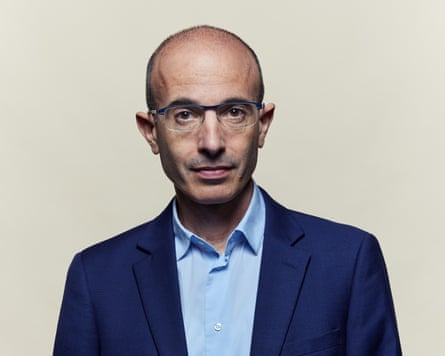

What happens when an internationally bestselling historian, a Nobel peace prize-winning journalist and a former politician get together to discuss the state of the world, and where we’re heading? Yuval Noah Harari is an Israeli medieval and military historian best known for his panoramic surveys of human history, including Sapiens, Homo Deus and, most recently, Nexus: A Brief History of Information Networks from the Stone Age to AI. Maria Ressa, joint winner of the Nobel peace prize, is a Filipino and American journalist who co-founded the news website Rappler. And Rory Stewart is a British academic and former Conservative MP, writer and co-host of The Rest Is Politics podcast. Their conversation ranged over the rise of AI, the crisis in democracy and the prospect of a Trump-Putin wedding, but began by considering a question central to all of their work: how to live a good life in an increasingly fragmented and fragile world?
当一位国际畅销书历史学家、一位诺贝尔和平奖获奖记者和一位前政治家聚在一起讨论世界现状和我们的未来方向时,会发生什么?尤瓦尔·赫拉利是一位以色列中世纪和军事历史学家,因其对人类历史的全景式调查而闻名,包括《人类简史》、《人类简史 2:从上帝到死亡》以及最新的《信息网络简史:从石器时代到人工智能》。玛丽亚·雷萨是菲律宾和美国记者,诺贝尔和平奖的共同获得者,共同创立了新闻网站 Rappler。罗里·斯图尔特是一位英国学者和前保守党议员,作家,也是《政治余波》播客的共同主持人。他们的对话涵盖了人工智能的崛起、民主危机以及特朗普-普京婚礼的前景,但首先考虑了一个贯穿他们所有工作的核心问题:如何在日益分裂和脆弱的世界中过上美好的生活?
YNH People have been arguing about this for thousands of years. The main contribution of modern liberalism and democracy was to try to agree to disagree; that different people can have very different concepts of what a good life is, and they can still live together in the same society, agreeing on some very basic rules of conduct. And the challenge was always that people who think they have the absolute answer to what is a good life try to impose it on others, partly because, unfortunately for many ideologies, an inherent part of the good life is attempting to make everybody live it. And even more unfortunately, in many cases, it seems that it is easier to impose it on others than to do it ourselves. If we take the original crusade in medieval Christian Europe, you have all these people who can’t live a Christian life of modesty and compassion and love your neighbour, but they are able to travel thousands of kilometres to kill people and try to force them to live according to these principles. And what we are witnessing in the world right now is more of the same.
YNH 人们关于这个问题争论了数千年。现代自由主义和民主的主要贡献是试图达成不同意见的共识;不同的人可以有不同的美好生活概念,他们仍然可以生活在同一个社会中,同意一些非常基本的道德规范。挑战始终在于,那些认为自己找到了美好生活绝对答案的人试图将其强加于人,部分原因是因为,对于许多意识形态来说,美好生活的固有部分就是试图让每个人都去实践它。而且,更不幸的是,在许多情况下,似乎强加于人比自己去实践它更容易。如果我们以中世纪基督教欧洲的原始十字军东征为例,你会有所有这些人,他们无法过一种谦逊、有同情心和爱邻如己的基督教生活,但他们能够旅行数千公里去杀人,试图强迫他们按照这些原则生活。而我们目前在世界看到的,更多的是同样的情况。
RS At the heart of that observation is this extraordinary idea, which, broadly speaking, is called liberalism. It is an idea that became very powerful, particularly by the 19th century, and found a new form after the second world war. We’re the heirs of that: it assumed things like a rules-based international order; an idea that we would agree how we behaved, state to state; it had an idea of democracy at its heart. And of course, that idea of democracy has a lot of the ingredients that Yuval is talking about, which is tolerance, human rights – how you protect the minority from the views of the majority. And there was an extraordinary period that probably lasted until the mid-2000s where it really seemed possible that this was the natural destination of humanity. And then things began to come off the rails. Now we find ourselves in a world where almost every bit of the model has entered its shadow form. So instead of focusing on democracy, we’re in a world dominated by authoritarian populism. Instead of a world of free trade, we’re in one that’s increasingly about protection and tariffs. Instead of a rules-based international order, we’re in a world of isolation: the strong do what they can, the weak must suffer what they must. And all this, of course, is then reinforced by social media and increasingly by AI.
RS 在这个观察的核心是一个非凡的想法,广义上被称为自由主义。这是一个在 19 世纪变得非常强大的想法,在第二次世界大战后找到了新的形式。我们是它的继承者:它假设了基于规则的国际秩序;一个国家与国家之间会就行为达成一致的想法;它以民主为核心。当然,这个民主理念包含了尤瓦尔所谈论的许多成分,比如容忍、人权——如何保护少数派免受多数派观点的影响。有一个非凡的时期,可能一直持续到 2005 年中期,那时这确实似乎是人类自然的归宿。然后事情开始偏离轨道。现在我们发现自己处在一个几乎每个模型部分都已进入其阴影形式的世界。因此,我们不再关注民主,而是处在一个受威权民粹主义主导的世界。不再是自由贸易的世界,而是一个越来越关于保护和关税的世界。 而不是基于规则的全球秩序,我们正处在一个孤立的世界:强者做他们能做的,弱者必须承受他们必须承受的。当然,这一切都由社交媒体和日益增长的 AI 加强。
MR The biggest question we have today is whether impunity will reign, because it’s clear from what is happening in the physical and virtual world that an international rules-based order is not working. How do you live a good life when big tech is using surveillance for profit, to manipulate us in order to keep making more money? Now we’re individually targeted by technology that can go to the cellular level of every democracy.
MR 我们今天最大的问题是是否将出现无责状态,因为从现实世界和虚拟世界发生的事情来看,基于国际规则的秩序不起作用。当大科技公司利用监控谋取利润,操纵我们以获取更多金钱时,你如何过上好生活?现在,我们正被能够深入到每个民主国家的细胞级别的技术个别针对。
All five major world religions say that the battle that matters in order to live a good life is the battle inside yourself: your better self versus your worst self. Do unto others as you would have them do unto you; it’s a simple thing. But how do we maintain these values when the very way we connect with each other is corrupted?
所有五大世界宗教都认为,为了过上好生活,真正重要的战斗是在你内心进行的:你的更好自我与最坏自我之间的战斗。以你希望别人如何对待你的方式对待他人;这是一件简单的事情。但当我们与他人连接的方式本身被腐蚀时,我们如何保持这些价值观呢?
YNH What is new in the current situation is that we now have the technology to hack human beings and manipulate the inner battle in a way that was simply impossible in the middle ages or even in the 20th century. Big corporations, and anybody wielding this new technology, can both decipher and also manipulate human desires and thoughts in a way that is unprecedented. And liberal democracy, as it was constituted in the 18th and 19th century, really doesn’t know how to deal with it.
YNH 当前情况下新的特点是,我们现在有了黑客攻击人类、操纵内心斗争的技术,这在中世纪甚至 20 世纪都是不可能的。大型企业和掌握这项新技术的任何人都可以以前所未有的方式解读和操纵人类的欲望和思想。而 18 世纪和 19 世纪形成的自由民主制度,实际上不知道如何应对这种情况。
RS There’s also the possibility that technology begins to overshadow us. If you think about civilisation, a lot of it traditionally was about these great figures, these role models, these heroes. And what is a hero? Somebody who stretches the limits of what it means to be human. We believe we are this extraordinary species who can do things in science or poetry or drama that no other species can do. The risk of artificial general intelligence is that suddenly it is quite literally superhuman. At that point, if it can effortlessly write a poem better than I can, create a play better than I can, suddenly we are diminished.
RS 技术开始超越我们的可能性也存在。如果你想想文明,很多传统上都是关于这些伟大人物,这些榜样,这些英雄。那么什么是英雄呢?一个能够拓展人类意义极限的人。我们相信自己是一个非凡的物种,能够在科学、诗歌或戏剧上做其他物种无法做到的事情。通用人工智能的风险在于,它突然变得字面上的超人类。到那时,如果它能够轻而易举地写出一首比我更好的诗,创作出比我更好的剧本,我们就会突然感到自己被削弱了。

MR It would be great if the technology that is enabling this transformation is actually 100% accurate. It is not. But because we’ve grown up with integrity of information, it’s much easier to fool us, because when you see it in writing, you expect it to be right. The way AI has been pushed in our society is completely separate from facts. And I know Yuval in his book says information is not about facts, it’s about the stories we tell, but facts anchor our shared reality.
MR 如果推动这种变革的技术实际上 100%准确就好了。但它并不准确。但由于我们从小就习惯了信息的完整性,所以更容易欺骗我们,因为当你看到它是写下来的,你会期望它是正确的。人工智能在我们社会中被推动的方式与事实完全无关。我知道尤瓦尔在他的书中说信息不是关于事实,而是关于我们讲述的故事,但事实是我们共享现实的锚。
A question I would like to ask you guys: do you think people are fundamentally good or fundamentally evil? I sound super religious in this conversation, but really that makes a difference, because what we’re doing now in the public information ecosystem, part of the breakdown of democracy, part of our ability to elect illiberal leaders democratically, is because we’ve muted the goodness of humanity. I’ve covered the crappiness of humanity, of people killing each other, I’ve been in war zones, but I’ve also been in these areas where a natural disaster happens and people are incredibly generous. We would not have survived the six-year presidency of Rodrigo Duterte if there were not people who gave not just of themselves, but gave money to Rappler. So I think this is what’s at stake.
我想问大家一个问题:你们认为人是天生善良还是天生邪恶?在这场对话中,我听起来好像非常宗教化,但事实上这很重要,因为我们现在在公共信息生态系统中所做的一切,部分是民主的破裂,部分是我们能够民主地选举非自由主义领导者的能力,都是因为我们已经抑制了人性的善良。我描述了人性的丑陋,人们互相残杀,我曾在战区,但我也曾去过这些发生自然灾害的地方,人们表现得极其慷慨。如果没有人们不仅奉献自己,还向《雷普勒》捐款,我们不可能度过罗德里戈·杜特尔特六年总统任期。我认为这就是我们所面临的风险。
YNH One of the most important observations is that goodness is not closely related to intelligence. Artificial intelligence is the most important technology of the era; it has been forgotten that intelligence is no guarantee of goodness or even of wisdom, that when you look at the grand span of human history, you don’t see a clear correlation between intelligence and compassion, or even a clear-sighted view of reality. Homo sapiens is by far the most intelligent species on the planet, and it simultaneously is the most deluded species: humans believe the kind of nonsense that no chimpanzee or elephant or rat would ever believe. We are now creating a superintelligence, and there is every reason to think that it will be super deluded.
YNH 最重要的观察之一是,善良与智力并不紧密相关。人工智能是这一时代最重要的技术;人们已经忘记了智力并不能保证善良,甚至也不能保证智慧,当你审视人类历史的广阔跨度时,你不会看到智力和同情心之间的明确关联,甚至也不会看到对现实的清晰认识。智人无疑是地球上最聪明的物种,同时也是最自欺欺人的物种:人类相信的那种连黑猩猩、大象或老鼠都不会相信的愚蠢。我们现在正在创造超级智能,有充分的理由相信它将会非常自欺欺人。
RS Yuval is unusual because he is capable of considering the possibility of where we might be in 200 years. But let’s try 20 for a second. When we think about the world, often we think about it from Silicon Valley, and we imagine that really the future is Star Trek, and Elon Musk is off to Mars. For most, perhaps half of humanity, over the next decades to come, hundreds of millions will be living on incomes of under $2 a day, and billions under $5 a day.
RS 尤瓦尔不同寻常,因为他能够考虑我们可能在 200 年后所处的位置。但让我们先尝试 20 年。当我们思考世界时,我们常常从硅谷的角度出发,想象未来就像《星际迷航》,而埃隆·马斯克正前往火星。对于大多数人来说,也许是人类的一半,在接下来的几十年里,数亿人将生活在每天不到 2 美元的收入水平上,数十亿人将生活在每天不到 5 美元的收入水平上。
The next thing is that conflict is changing. We can see with what’s happening in Gaza and to some extent in Ukraine, the way in which wealthy countries with technology can inflict astonishing damage on their neighbours and take very little risk themselves. Added to that, there is a push towards an arms race happening all over the world. So if we look at Europe, we’re now increasing our spending on defence to 5% of GDP. That will literally suck hundreds of billions of euros every year out of our health systems, our education systems, our welfare systems, at exactly the moment that our economies are flatlining and our populations are getting older, so there’s every likelihood that over the next 10-20 years, at the same time as AI is developing, much of the world will begin to feel like a shabbier, poorer version of the current world, that median incomes will stagnate and that conflict will rise.
接下来,冲突正在发生变化。我们可以看到,在加沙和一定程度上在乌克兰发生的事情,富裕国家如何利用技术对邻国造成惊人的破坏,而自己承担的风险却非常小。再加上,全球范围内正出现一场军备竞赛的推动。因此,如果我们看看欧洲,我们现在正在将国防开支增加到 GDP 的 5%。这实际上每年将从我们的卫生系统、教育系统、福利系统中吸走数百亿欧元,而此时我们的经济正处于停滞状态,人口也在老龄化,因此在未来 10-20 年内,随着人工智能的发展,世界的大部分地区可能会开始感觉像当前世界的简陋、贫穷版本,中位数收入将停滞不前,冲突将上升。

MR I completely agree with what Rory said, but I’m more pessimistic. I don’t think it’ll take 20 years. The Philippines gets an average of 20 typhoons every year. We’re watching islands sink, and yet the west is debating whether climate change even exists.
MR 我完全同意罗里的说法,但我更悲观。我认为不会等到 20 年。菲律宾每年平均有 20 次台风。我们看着岛屿沉没,而西方却在争论气候变化是否存在。
I think the death of journalism is around the corner within six months to a year. The internet is getting worse by the day, and there are absolutely no guardrails put in place, even as news organisations are being forced to pay for that, and our content is exploited. It is a very predatory online world, and that has translated to the world we live in.
我认为新闻业的死亡就在六个月到一年之内。互联网每天都在恶化,而且根本没有任何防护措施被实施,尽管新闻机构被迫为此付费,我们的内容也被剥削。这是一个非常掠夺性的网络世界,这已经反映在我们生活的世界中。
YNH If I had to characterise the emotional tone of what I have been doing for quite a number of years, I would say that I was in the business of anxiety – that I’m creating more anxiety around AI, climate change, whatever. Now we need to switch to a different project, which is to rebuild trust, because when there is too much anxiety and you can’t trust anybody or anything, you can’t do anything. The most important thing is to rebuild trust in human institutions, in the media, in government, elsewhere. The big question is, how do we do that?
YNH 如果我必须描述我过去多年所做的事情的情感基调,我会说我在做焦虑的生意——我在 AI、气候变化、 whatever 上制造更多的焦虑。现在我们需要转向一个不同的项目,那就是重建信任,因为当焦虑过多,你无法信任任何人或任何事时,你就无法做任何事情。最重要的是在人类机构、媒体、政府、其他地方重建信任。最大的问题是,我们如何做到这一点?
RS I would say that that involves rebuilding those human institutions. My experience as a politician is that government is much worse than I could ever have imagined. Liz Truss, my boss and colleague, who became prime minister in the United Kingdom, basically thought that her job was Instagram and campaigning, and she dedicated very little time to any serious consideration of policy, and in fact was derogatory of people who worried too much about the real-life impacts of what she was doing. The whole thing has become a game.
RS 我会说,这涉及到重建那些人类机构。我作为一名政治家的经验是,政府比我之前想象的要糟糕得多。我的上司和同事,英国首相利兹·特拉斯,基本上认为她的工作是 Instagram 和竞选活动,她很少花时间认真考虑政策,实际上她还贬低那些过于担心她所做的事情对现实生活影响的人。整个事情都变成了一场游戏。
MR How long will we pretend that there is integrity of elections as the world falls off the cliff? Part of what made the international rules-based system work was that we had a powerful anchor for it: that we did what was for the greater good. We expected leaders to pull back from their greed. And if they didn’t, journalists would expose these things. Now that the US doesn’t seem to care about any other country but itself, what will that mean? Does that mean that we throw away every value system that was built into the international organisations? If the most powerful only work for themselves, is it every person for themselves?
霍夫曼先生,我们还能假装选举的完整性存在多久,直到世界跌入悬崖?国际基于规则的系统之所以能运作,部分原因是我们有一个强大的支柱:我们做了对大家都有益的事情。我们期待领导者能从他们的贪婪中退却。如果他们做不到,记者会揭露这些事情。现在美国似乎只关心自己,这会意味着什么?这意味着我们要抛弃所有国际组织内建立的价值体系吗?如果最强大的人只为自己的利益工作,那是不是每个人只为自己?

YNH You see a re-emergence, in a strange way, of monarchist ideas: the leaders that are rising now are quite different from the 20th-century dictators. It’s not a coincidence that, in the US, one of the movements against Donald Trump is “No Kings”, because he is reviving something really medieval. One of the most amazing moments of the last year was the meeting between President Trump and President Zelenskyy in the White House. One of the things that emerged very clearly was that Trump does not think about politics as being an interaction between states or between people, in the sense of the American people, the Russian people, the Ukrainian people. He thinks about it as an interaction between persons, monarchs, dynasties. When people told him that Putin had broken previous agreements, Trump said, “Well, he broke an agreement with Biden, he broke an agreement with Obama, not with me.” And the implication is, the agreement is not between Russia and the US, the agreement is between two people, and if I make an agreement with Putin, I will make sure he sticks by it, but it only holds as long as I’m president. If you then replace me with someone else, that’s the end of the agreement. You see the return of the concept of politics as a dynastic affair between families. This is a bit crazy, but not too crazy, to think, for instance, of a solution to the Ukraine war where Barron Trump would marry Putin’s granddaughter, and they would get Crimea and Donbas as their kingdom.
您看到,以一种奇怪的方式,君主制思想正在重新出现:现在崛起的领导者与 20 世纪的独裁者截然不同。在美国,反对唐纳德·特朗普的一个运动是“无国王”,这并非巧合,因为他正在复兴一些真正中世纪的东西。去年最令人惊讶的时刻之一是特朗普总统与泽连斯基总统在白宫的会面。其中非常明显的一点是,特朗普并不认为政治是国与国之间或人民之间(如美国人民、俄罗斯人民、乌克兰人民)的互动。他认为这是个人、君主、王朝之间的互动。当有人告诉他普京破坏了之前的协议时,特朗普说:“好吧,他破坏了与拜登的协议,破坏了与奥巴马的协议,但不是与我。”这意味着,协议不是在俄罗斯和美国之间,而是在两个人之间,如果我与普京达成协议,我会确保他遵守它,但这只在我担任总统期间有效。如果你用别人取代我,那么协议就结束了。 您看到政治被视为家族世袭事务的概念正在回归。这有点疯狂,但也不是太疯狂,比如,考虑一下解决乌克兰战争的方案,巴伦·特朗普会与普京的孙女结婚,他们将以克里米亚和顿巴斯作为他们的王国。
Let me just say one more thing about this monarchical idea: in the 20th century, dictators served an ideology which, in a way, limited them, because if you’re, say, a communist dictator, you have to promote a communist ideology. You can’t really do what you want. With the new leaders like Trump, there is no ideology there. When you look at somebody like Trump or like Benjamin Netanyahu in Israel, the amazing thing is how much freedom of action these people have.
关于这种君主制想法,我再说一点:在 20 世纪,独裁者服务于一种意识形态,这在某种程度上限制了他们,因为如果你是比如说一个共产主义独裁者,你必须推广共产主义意识形态。你实际上不能做你想做的事情。对于像特朗普这样的新领导人,那里没有意识形态。当你看到像特朗普或以色列的本雅明·内塔尼亚胡这样的人时,令人惊讶的是这些人有多么大的行动自由。
RS One thing that is so striking about the modern age is that we’ve lost an ethical vocabulary in engaging with leaders. I mean, fundamentally, what is Donald Trump? He is shameless. It would be very difficult for Aristotle or Cicero or a Renaissance theorist of politics, or indeed the writers of the American constitution, to imagine this degree of shamelessness, this degree of contempt for constitutions, contempt for minorities, contempt for the truth, the open performance of immorality. And very difficult also to imagine that we would have entered a world where we, at some level, are so tempted to just enjoy the spectacle, and have just lost the ability to be shocked that every day he does three or four things which in the old world would have shocked us to our core.
RS 现代时代的一个显著特点是我们在与领导者互动时失去了道德词汇。我的意思是,从根本上说,唐纳德·特朗普是谁?他是一个厚颜无耻的人。亚里士多德、西塞罗或文艺复兴时期的政治理论家,或者确实是美国宪法的起草者,很难想象这种程度的厚颜无耻,这种程度的对宪法的蔑视,对少数群体的蔑视,对真相的蔑视,对不道德行为的公然表演。而且也很难想象我们会进入一个世界,在这个世界里,我们在某种程度上如此容易被诱惑,只是享受这场 spectacle,我们已经失去了对每天他做的三四个在我们旧世界会震惊我们灵魂的事情感到震惊的能力。
MR With Zelenskyy at the White House, it was shocking that the breaking news reporters just kept repeating what President Trump said, which was a lie. They could instead have used what is known as a truth sandwich: “Russia invaded Ukraine, President Trump says this, Russia invaded Ukraine.” In journalism, we have to shift: we can no longer stand behind “he said, she said”. Now we actually have to pull up and say, “This guy is lying.” Because those are the facts. So our reporting shifts. On the technology, we cannot live under surveillance for profit, we cannot keep getting manipulated in this way, because it encourages the worst of who we are. [At Rappler] we began to build a chat app two years ago. Our vision is for a global information ecosystem, but we anchor our news organisations with our communities. So this is how we move forward: we embrace the technology. We call it out where it is wrong. We look back at our history, and regardless of all of the problems of democracies, we still haven’t found a better system than this. Of course, it could all end soon, but we keep fighting.
在与泽连斯基在白宫的会面中,令人震惊的是,新闻 Breaking News 的记者只是不断地重复特朗普总统所说的谎言。他们本可以使用所谓的“事实三明治”: “俄罗斯入侵了乌克兰,特朗普总统说……,俄罗斯入侵了乌克兰。”在新闻业中,我们必须转变:我们不能再站在“他说,她说”的后面。现在我们实际上必须站出来并说,“这个人正在撒谎。”因为这些是事实。因此,我们的报道发生了转变。在技术方面,我们不能为了利润而生活在监控之下,我们不能继续以这种方式被操纵,因为这会激发我们最糟糕的一面。[在 Rappler],我们两年前开始开发一个聊天应用。我们的愿景是一个全球信息生态系统,但我们用我们的社区来锚定我们的新闻机构。因此,我们就是这样前进的:我们拥抱技术。我们指出它的错误。我们回顾我们的历史,尽管民主制度存在所有问题,但我们还没有找到比这更好的制度。当然,这一切可能很快就会结束,但我们仍在战斗。
YNH I think that more people need to realise that we have to do the hard work ourselves. There is a tendency to assume that we can rely on reality to do the job for us. That if there are people who talk nonsense, who support illogical policies, who ignore the facts, sooner or later, reality will wreak vengeance on them. And this is not the way that history works.
YNH 我认为更多的人需要意识到,我们必须自己付出努力。有一种倾向是认为我们可以依赖现实来为我们完成任务。如果有的人说废话,支持不合理的政策,忽视事实,迟早现实会报复他们。但这并不是历史运作的方式。
So if you want the truth, and you want reality to win, each of us has to do some of the hard work ourselves: choose one thing and focus on that and hope that other people will also do their share. That way we avoid the extremes of despair.
所以,如果你想了解真相,想让现实获胜,我们每个人都需要自己做一些艰苦的工作:选择一件事情并专注于它,并希望其他人也能尽自己的一份力。这样我们就能避免绝望的极端。
