

As a child I devoured books until my eyes blurred. When my GCSEs came around, I exercised the stamina of a monk, revising for hours without pause. But in recent years, I’ve watched that capacity for intense concentration dissolve into infinite scrolling on my phone. My attention span now contracts like a slug at the touch of a finger. Reading for pleasure feels less like nourishment and more like endurance training. And for someone who writes for a living, this is a professional hazard as well as something that made me sad. I wanted to restore that mental elasticity, to halt the brain rot.
作为一个孩子,我如饥似渴地阅读,直到眼睛模糊。当我的 GCSE 考试临近时,我像和尚一样锻炼耐力,连续数小时不停歇地复习。但近年来,我眼睁睁地看着这种高度集中的能力在我手机上的无限滚动中消散。我的注意力跨度现在像被手指触碰的蜗牛一样收缩。为了娱乐而阅读感觉不再像滋养,更像耐力训练。对于一个以写作为生的人来说,这既是职业风险,也是让我感到悲伤的事情。我想恢复那种心理弹性,阻止大脑腐烂。
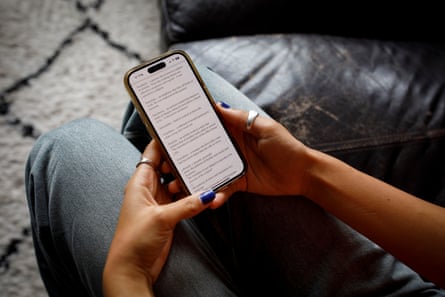
So, about a year ago, I made a small vow: every time I came across a word I didn’t know – whether in a novel, an article, or an overheard conversation – I would look it up and write it down. Nothing elaborate, no leather-bound journal or fountain pen. Just a running list kept, ironically, on my phone. Each week, I’d spend a few minutes reading the list back in an attempt to lodge the word into my memory.
所以,大约一年前,我发了一个小誓愿:每次我遇到不认识的词——无论是小说、文章还是无意中听到的对话——我都会查一下并记下来。没有什么复杂的,没有皮质封面笔记本或钢笔。只是简单地记录在手机上。每周,我会花几分钟回顾这个清单,试图将这些词记在脑子里。
The list now spans almost 20 pages, and this tiny ritual has been quietly transformative. The payoff is less about peacocking with obscure adjectives – which, let’s face it, can make you sound insufferable – and more about the mental calisthenics of the ritual. Each time I look up and record a word, I feel a faint stretch, as though some neglected part of my brain is flexing again. Even if I never deploy “eidolon” in conversation, the very act of noticing, logging and revising it interrupts the slide into passive, semi-skimmed attention.
现在这个列表已经扩展到近 20 页,这个微小的仪式已经悄然地改变了我。这种回报与其说是用生僻的形容词炫耀——说实话,这可能会让你显得难以忍受——不如说是这个仪式的心理锻炼。每次我抬头记录一个单词,我都会感到一种微妙的拉伸,就像我大脑中被忽视的部分再次开始活动。即使我永远不会在对话中使用“eidolon”,仅仅注意到、记录并修订它就能打断我滑向被动、粗略阅读的倾向。

对抗大脑的退化……艾玛在家里,用手机列单词。
There is also a journalling element to it – it functions as something of a diary, a record of where I’ve been reading, what I’ve been thinking about and who I’ve been listening to.
这个仪式还有一个日记元素——它就像一本日记,记录了我阅读的地方、我在想什么以及我在听谁。
Not that it’s an easy habit to keep up. It is often extremely impractical. If I’m reading on the tube, I have to stop mid-paragraph, pull out my phone and type “millenarianism” into my Google doc while trying not to elbow the stranger pressed against me. It can slow my reading to a maddening crawl. (The Kindle, with its built-in dictionary, is much kinder). And then there’s the revising (which I often forget to do), dutifully scrolling through my growing word-hoard like I’m preparing for a vocabulary test.
这不是一个容易保持的习惯。这通常非常不切实际。如果我正在地铁上看书,我必须在中途停下来,拿出手机,在我的谷歌文档中输入“千年至福论”,同时试图不碰到挤在我身上的陌生人。这可能会让我的阅读速度慢得让人抓狂。(Kindle 内置词典,要仁慈得多)。然后还有修订(我经常忘记做),像准备词汇测试一样,尽职尽责地滚动查看我日益增长的词汇库。
Realistically, I incorporate maybe 5% of these words into my everyday speech. “Incorrigible” made the cut. “Lugubrious” too. But most of them remain like museum pieces – admired and catalogued but rarely handled.
实际上,我只将其中 5%的词汇融入我的日常对话中。“Incorrigible”成功入选。“Lugubrious”也是如此。但大多数词汇仍像博物馆藏品一样——受人钦佩并被编目,但很少被使用。
Still, it’s made my mind much sharper. I find myself reaching less often for the same tired handful of adjectives, and more often for something precise and muscular. Few things are more satisfying than unearthing the exact word you were searching for – like finding the missing puzzle piece that locks the picture into place.
然而,它使我的思维变得更加敏锐。我发现自己在很少使用那些陈词滥调的形容词,而更频繁地寻找精确而有力的词汇。没有什么比找到你一直在寻找的确切单词更令人满足的了——就像找到那个缺失的拼图碎片,将画面完美拼合在一起。
In an era when our devices siphon off our attention with merciless efficiency, it feels subversive to use mine as a tool for slow thinking. And it has given me back something I feared I’d lost – the pleasure of exercising a mind that, after years of slack scrolling, is finally waking up again.
在这样一个我们的设备以无情的高效方式吸走我们注意力的时代,用我的设备作为慢思考的工具感觉是一种颠覆。它还给了我一件我害怕已经失去的东西——享受锻炼思维带来的乐趣,经过多年的懒散滚动,我的思维终于再次苏醒。
